Things To Look For When Buying An RV

Many have asked the questions about what do you look for before purchasing an RV? Most start with the basics, such as find a floor plan that suits your needs. Living space is one area, but like a house you need to delve deeper to find out as much about it as you can before plunking down the money or signing a loan contract. Since you are buying something on wheels, you need to treat it both as you would a vehicle and a house. Mechanical inspection should be done by a qualified mechanic, while the “house” and its amenities should be inspected by someone who is much like a qualified home inspector…which isn’t always easy to find someone who can do both.
 In this series I will point out items that you need to be mindful of when purchasing or if you already own an RV. I’ll use our own and what we found and learned from as well as those issues shared by others we have met along the road.
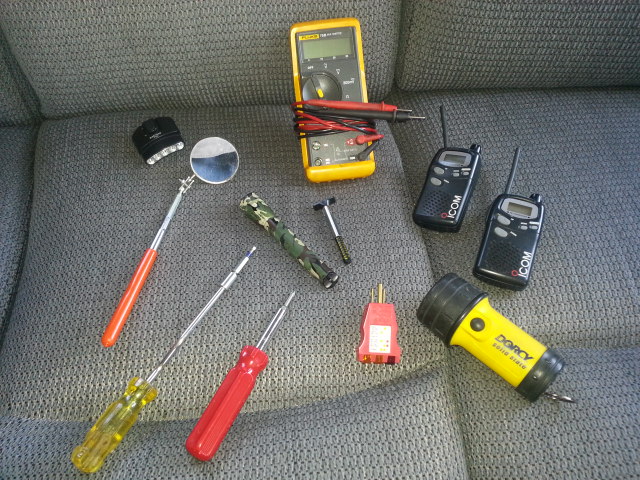
Before you go “looking” at an RV or already bought one you need to have an inspection kit which consists of a couple of flashlights, a mechanics inspection mirror, multimeter, outlet tester, tire depth gauge, screw drivers, square screw driver and a pair of walkie talkies. You’ll eventually want a pair of the handheld communicators, they’re handy when you need to hear what your spotter is saying while backing into your campsite. For this application, someone may need to be outside and if there is a motor running, it will be easier to hear each other. Nothing worse than not being able to communicate…TURN OFF THE WATER…NOW!..when you’re shoulder deep inside the RV and your partner is outside manning the water spigot.
Be prepared to get down on your hands and knees! You are going to stick your head (if it will fit) into every crack, corner and opening inside and out of the unit to look every square inch over carefully.
Put aside those excited feelings of “this is the one for us!” Too often people let their emotions control the purchasing process and fail to follow sound inspection practices which leads to finding themselves with a case of buyers remorse soon afterwards because they didn’t do a thorough inspection to find the RED FLAGS that would have killed the deal had they known!
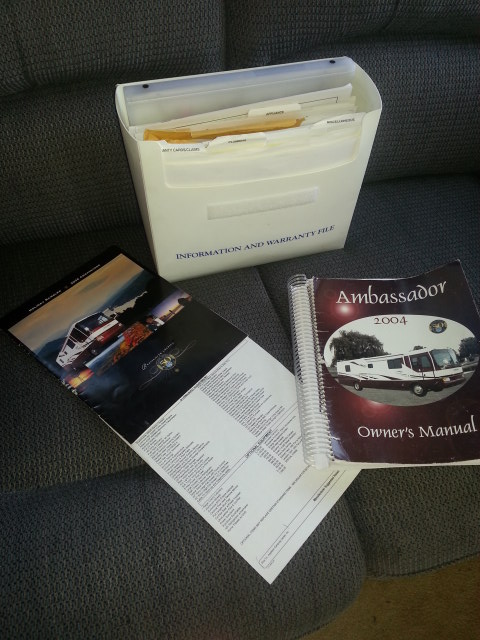 To start things off, review what documentation about the vehicle is provided and will accompany it. We were fortunate to have the complete owner’s manual package as well as the original sales brochure and invoice/window sticker. With these valuable resources doing the pre-purchase inspection is so much easier because you have the answers to the proper operation of the equipment included. It also has been a saving grace when it comes to learning how things work, how to operate them properly and what procedures to follow to maintain them.
Okay so lets start by standing outside and taking a look at the unit from a short distance away from several points of the compass. Does it appear to have anything jumping out at you that raises concern or questions? If so, make a note to take a closer look and ask questions! Look at the cosmetic appearance, has it been cared for…washed and waxed regularly or is it covered with black streaks or have mold growing on the roof? Does it lean to one side, flat tires, droopy rear end?
On the mechanical/vehicle side of our rigs inspection I had the ability to tap the knowledge and experience of a good friend who works in the commercial truck industry as a fleet maintenance supervisor, who had decades of experience servicing vehicles with similar power and drive trains as our motor home. He spent over an hour on a creeper under the rig with flashlight and inspection mirror checking it from front to back. Then poked his head into every access panel or compartment we could open. This all on the dealership’s lot! Note: If the dealership refuses you to do this sort of inspection…walk away.
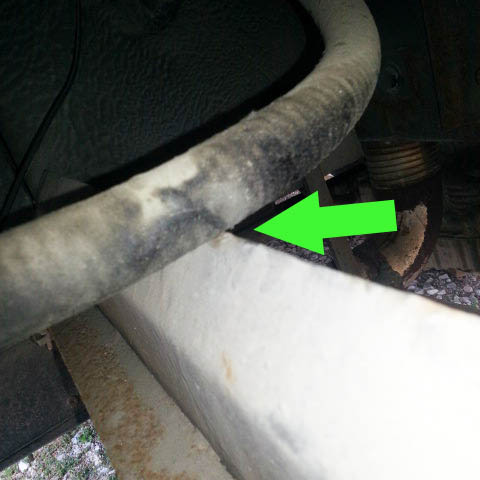 He found nothing obvious and felt what he had seen raised no concerns but he did point out a few items that I needed to watch carefully over time. These items are probably something most novices would never have seen unless you had experience with such vehicles. A simple one is anywhere there are cables, wires or hoses making contact with metal or wood (inside) edges such as this hose that rests on a support bracket.
Vibration and bouncing can and WILL cause the hose casing to be compromised, so one must pay attention to this and take preventative measures as needed. If the hose is showing definite signs of wear, ask that it be replaced or deduct the cost of the hose and labor from the purchase price. In this case I will fabricate a hanger to keep the hose away from the bracket or attach at pad to the bracket to guide and protect the hose. Since RVs have lots of hoses, wires and cables this is a reason why you need to poke your head in look at everything very closely…under, inside and out!
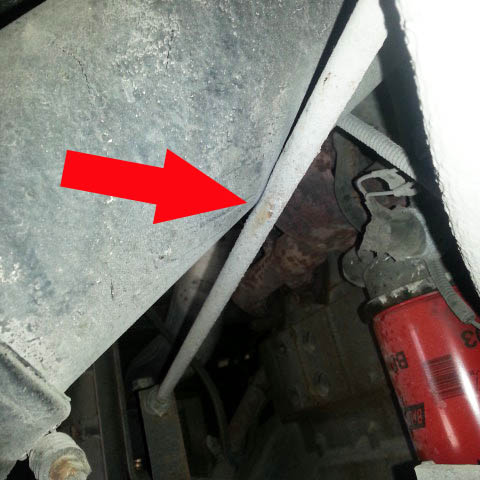 Another area that requires vigilance is on the motor itself. This is something some would say is a design flaw…I agree. Here the tube (gray piece behind the red arrow) that goes between the air filter canister and the engine itself intersects with a support rod for a completely different component. The two touch although barely, but enough contact is made from the vibration of the engine and the road that…well it can wear a hole through that tube. What’s the big deal with that you ask? Well once it does, the engine will start to suck in air through that hole…that’s unfiltered air…full of dust and dirt which is then injected into the engine with the fuel. This will lead to premature piston, cylinder and valve failure…in short a costly engine overhaul.
Both of these two examples are similar but often missed during a pre-purchase inspections…this goes for NEW units as well. If you see things like this on a new unit ask about it. See if there is a Service Bulletin or a Recall. If not, be sure to document it at the time of purchase and keep an watchful eye on it!
I’ll point out more things in future posts. One more add on to that inspection kit…an inexpensive digital camera. It can be used to document the inspection and if you can’t see something by sticking your head in, or using the mirror just stick in the camera and take a couple quick shots and look at the images to see what’s there. The camera often will see more than the naked eye can anyway. Be sure to take pictures of the inside, outside and importantly the issues you discovered. It will help you decide when comparing multiple units you are considering to purchase, as well as serve as a great negotiation tool when making the final deal.
When considering any RV for purchase…test operate every component of the unit. EVERYTHING! Invest the time now, so you don’t have to spend more time, money and frustration later.

